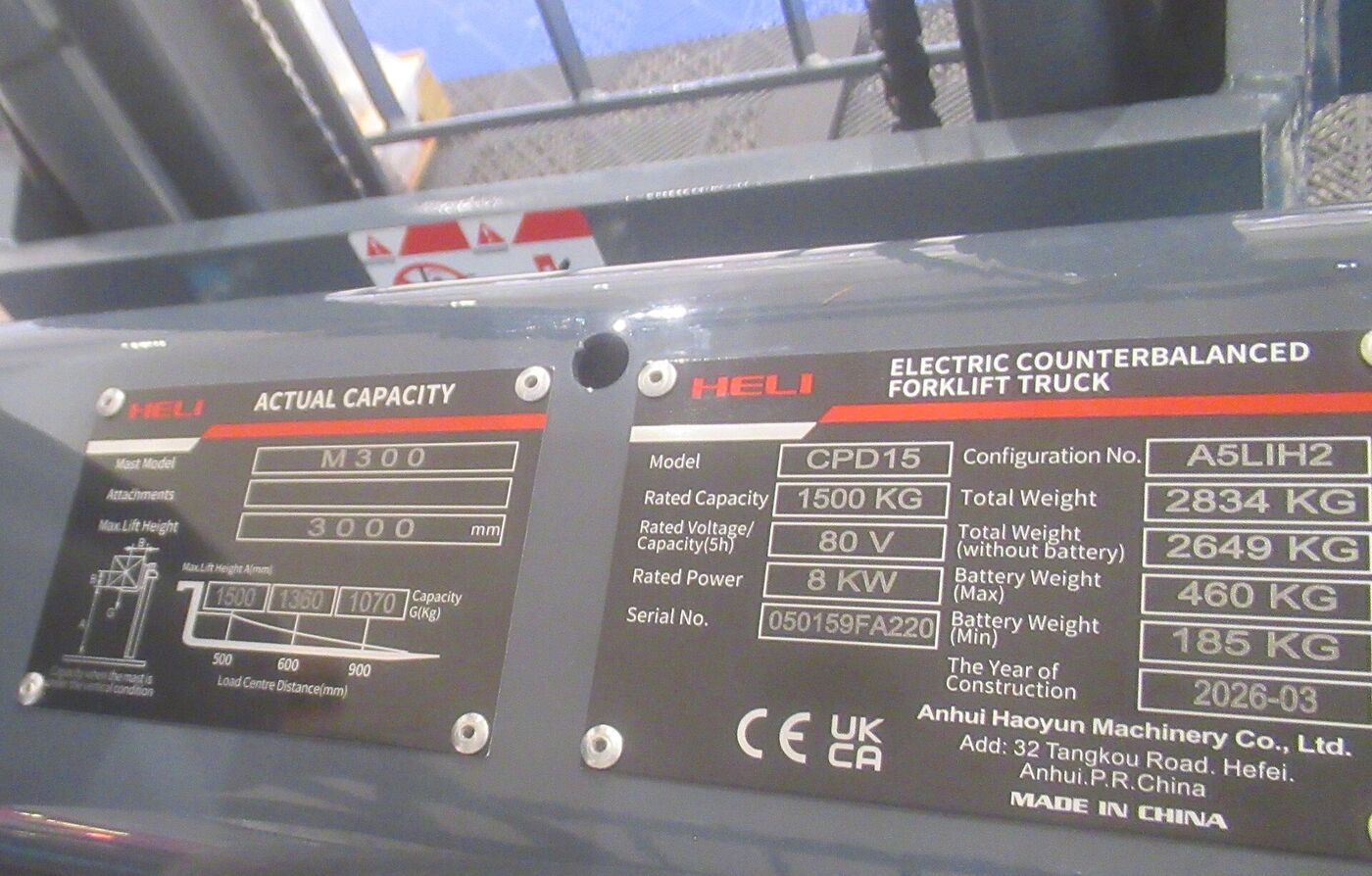

Why forklifts tip over, what the stability triangle is, how the load centre changes what a truck can lift, and how to read the capacity plate before every unusual load.
Why forklifts tip over
A counterbalance truck is a seesaw. The front axle is the pivot, the load sits on one side and the counterweight and the truck's own mass sit on the other. As long as the combined centre of gravity of truck and load stays over the base formed by the wheels, the truck is stable. Move it outside that base and the truck tips, either forward over the front axle or sideways over one of the front wheels.
Overturns are the single biggest cause of forklift operator deaths. Most happen at low speed, on level ground, with an ordinary load, because of a combination of small things: a load slightly heavier than the operator thought, the mast tilted forward, a turn taken a little too fast.
The stability triangle
Seen from above, a three-wheel truck is supported at three points: the two front wheels and the rear wheel. A four-wheel truck behaves the same way, because the rear axle pivots at its centre. That gives a triangle, and the combined centre of gravity must stay inside it.
Notice how narrow the triangle is at the back. A small sideways shift of the centre of gravity, from cornering, a side slope or an off-centre load, has a much bigger effect when the load is high. Raising the load also raises the centre of gravity, which makes the truck less able to tolerate that sideways shift. That is why the rule is travel with the load low and the mast tilted back.
Load centre
The load centre is the distance from the face of the forks to the centre of gravity of the load. Rated capacity is always quoted at a particular load centre, usually 500 mm for trucks up to around five tonnes and 600 mm for larger ones. That is the centre of a standard 1,000 mm pallet.
Move the load centre out and the lever arm gets longer, so the truck can lift less. A truck rated at 2,000 kg at 500 mm cannot lift 2,000 kg of anything longer than a metre. It also cannot lift 2,000 kg on a pallet that is sitting 200 mm off the heels of the forks. The calculation is straightforward, but most operators should not need to do it: if the load is bigger, longer or lifted higher than the plate allows, stop and ask.
Reading the capacity plate
Every truck has a capacity plate, usually on the dash or the side of the overhead guard. It shows the rated capacity at the stated load centre and lift height, and it often shows a reduced capacity for higher lifts or for a fitted attachment. Things to remember:
- The plate is for the truck as fitted. Add a sideshift, a clamp or a longer set of forks and the capacity changes. There should be a separate plate or a revised plate for each attachment.
- Capacity usually falls at full lift height. Trucks with tall masts often have two or three figures on the plate.
- Capacity assumes level ground and a mast tilted back or vertical. On a slope or with forward tilt the safe load is lower.
- Worn forks reduce capacity. If the heels are 10 per cent worn the forks should already have been replaced.
- If the plate is missing or unreadable, the truck should not be used until it is replaced.
Things that push the centre of gravity outside the triangle
| Cause | What happens | What to do instead |
|---|---|---|
| Cornering with a raised load | Sideways force plus a high centre of gravity tips the truck laterally | Lower the load before turning. Slow down. |
| Forward tilt with a raised load | Moves the load away from the truck. Common when placing at height. | Tilt only enough to place the load, and only when it is over the rack beam. |
| Braking hard with a raised load | Momentum carries the load forward | Travel with the load low. Brake gently. |
| Driving across a slope | Sideways shift with no warning | Drive straight up and down slopes, never across. |
| Uneven or soft ground, potholes, kerbs | One wheel drops and the base tilts | Use rough terrain trucks outdoors. Report ground defects. |
| Off-centre or unstable loads | Centre of gravity is not where the operator assumes | Centre the load on the forks. Reject loads that are damaged or shifting. |
If the truck starts to tip
Key points
- Overturns are the leading cause of forklift operator deaths, and most happen at low speed.
- The combined centre of gravity must stay inside the stability triangle. Height and sideways force both shrink the margin.
- Rated capacity is only valid at the stated load centre. Longer or offset loads reduce it.
- The capacity plate is for the truck as fitted. Attachments and worn forks reduce capacity.
- If the truck tips, stay in the seat, brace and lean away. Wear the seat belt.
Sources and further reading
- HSE L117, sections on stability and safe operation
- HSE, Workplace transport safety: an employers' guide (HSG136)
- BITA guidance on rated capacity and attachments