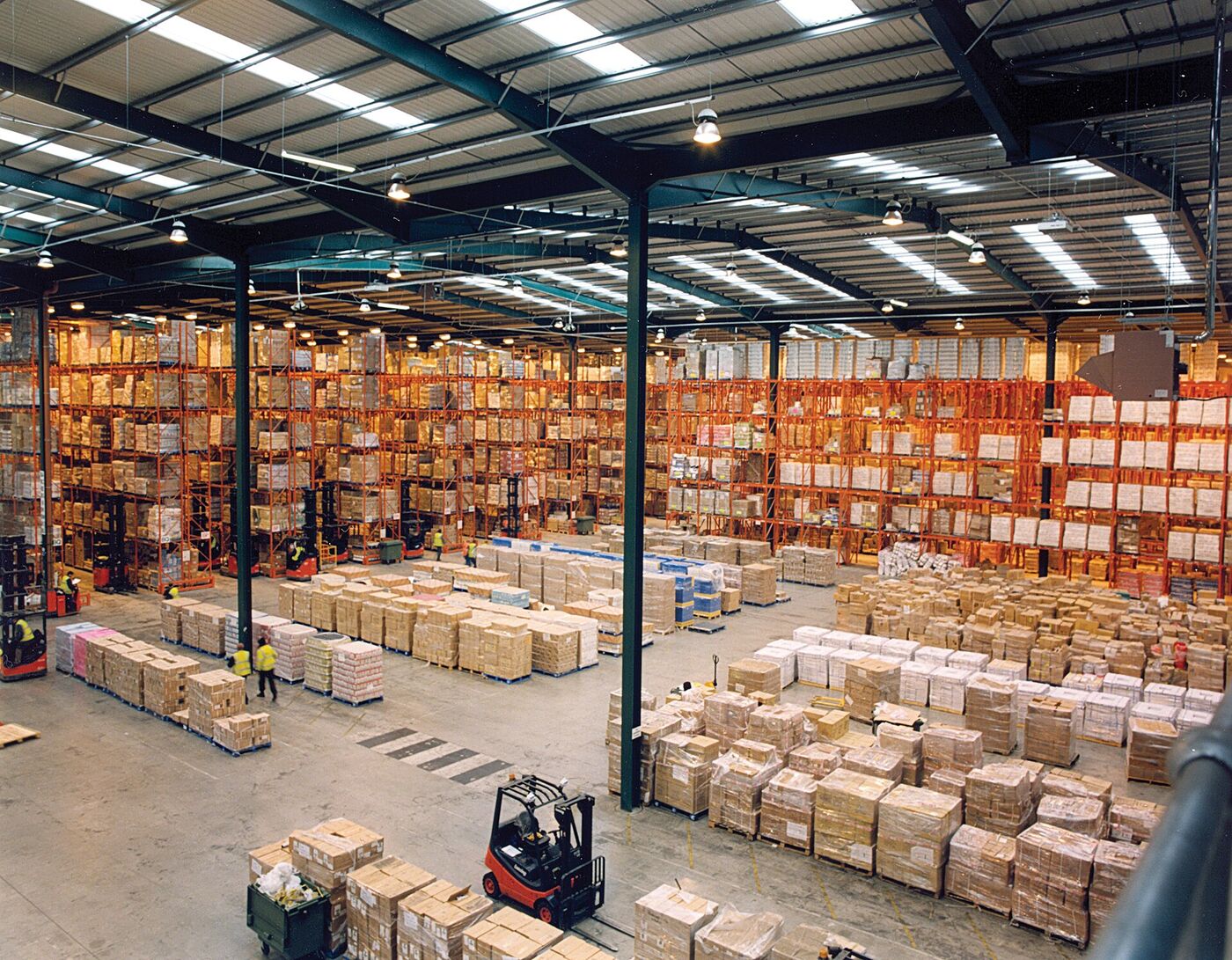

Racking collapses are rare but catastrophic, and almost always caused by forklift impact. How to place and retrieve loads at height, and how to spot damage before it matters.
Racking is work equipment too
Pallet racking is covered by PUWER in the same way a forklift is. It must be suitable for the loads, installed correctly, inspected and maintained. Every run of racking should carry a load notice showing the maximum load per beam level and per bay, and operators should know where to find it and what it means.
The standard reference is SEMA's guidance and the HSE's HSG76, Warehousing and storage. Both make the same point: the overwhelming majority of racking failures follow impact damage from a forklift that was not reported.
Placing a load
- Approach the bay squarely and stop with the mast vertical, about 300 mm from the beam face.
- Check the load notice. Confirm the pallet and its contents are within the beam and bay limits.
- Raise the load to just above beam height. Keep the mast vertical or slightly back until the load is above the beam.
- Drive forward slowly until the pallet is centred front to back on the beams, with equal overhang.
- Lower gently until the pallet is seated on both beams. Tilt forward only enough to free the forks. Never drop a load onto the beams.
- Reverse straight out until the fork tips clear the pallet, then lower the forks to travel height before turning.
A pallet must rest on both beams with the deck boards running across them. Never place a pallet on one beam, on the end frames, or on top of another pallet in the rack.
Retrieving a load
- Position squarely, forks level, at pallet entry height.
- Insert the forks fully. Partially inserted forks lift the pallet off balance and can pull it apart.
- Lift just enough to clear the beams, tilt back slightly, and reverse straight out.
- Lower to travel height before moving off.
Watch for damaged pallets, loads that have shifted, stretch wrap that has split, and anything overhanging into the aisle. A pallet that looks doubtful at the rack is much easier to deal with than one that collapses on the forks at full height.
Height and reach
The higher the load, the smaller the stability margin and the harder it is to see. Operators placing at height should be trained specifically for it, and the truck must be rated for the load at that height. Reach trucks and very narrow aisle trucks exist because counterbalance trucks are the wrong tool above a certain height in a confined aisle.
Rack damage
SEMA's traffic-light system is the simplest way to categorise damage.
| Level | Meaning | Action |
|---|---|---|
| Green | Deflection within limits | Record and monitor |
| Amber | Damage beyond limits but not yet critical | Unload the affected bay as soon as practical. Do not reload until repaired. |
| Red | Serious damage | Unload immediately. Isolate the bay. Repair before use. |
An upright bent by more than 5 mm over a metre length in the direction of the beams, or 3 mm across, is amber. Anything worse, any tear, any missing base plate bolt or any missing beam lock is red. Repair means replacing the component. Straightening a bent upright is never acceptable.
Preventing impact damage
- Column guards and rack-end barriers at every aisle entrance and on every upright facing a transfer aisle.
- Aisles wide enough for the trucks in use, with clear floor markings.
- Adequate lighting at all levels of the rack.
- A culture where operators report every knock without fear. A reported knock costs a few hundred pounds. An unreported one can cost a life.
- Weekly visual checks by a trained member of staff and an annual inspection by a SEMA-approved inspector.
Key points
- Almost every racking collapse follows unreported forklift impact damage.
- Every run of racking needs a load notice, and operators need to read it.
- Approach squarely, keep the mast vertical, place gently on both beams, and lower before turning.
- Use the SEMA traffic-light system for damage. Repair means replace, never straighten.
- Protect uprights physically and inspect racking weekly and annually.
Sources and further reading
- HSE, Warehousing and storage: a guide to health and safety (HSG76)
- SEMA, Guide to the conduct of pallet racking and shelving surveys
- HSE L117