.jpg)
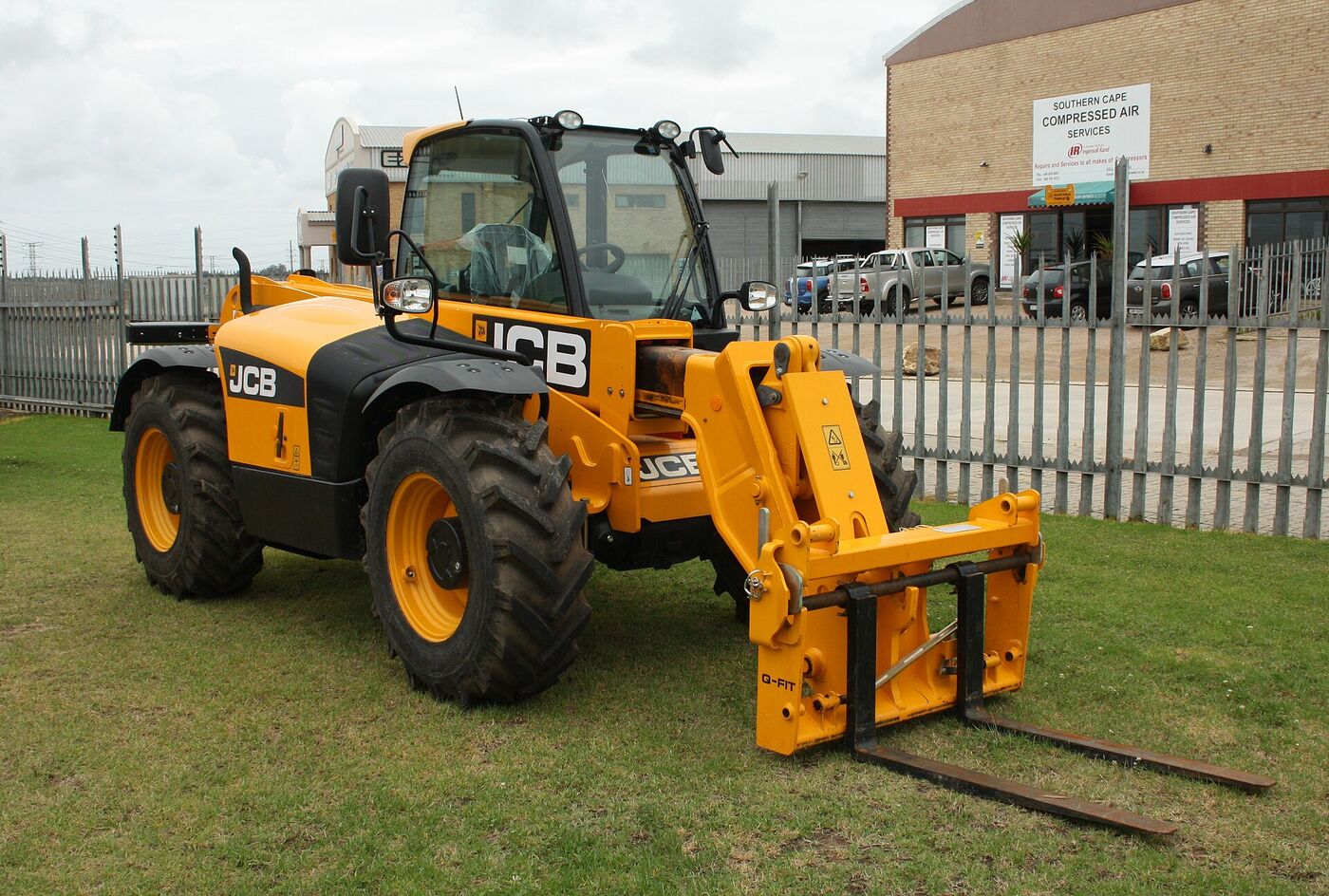
A telehandler is a forklift whose load moves away from it. Load charts, boom extension, stabilisers, working near people and lifting with attachments all need more than counterbalance training.
What makes a telehandler different
On a counterbalance truck the load centre is fixed by the fork length. On a telehandler the boom extends, so the load centre can move from less than a metre to several metres in front of the machine, and it can be raised to ten metres or more at the same time. The stability calculation changes every second the boom is moving. That is why telehandler operators need their own certificate, and why a counterbalance certificate does not cover them.
Two of the incident reports on this site involve telehandlers: one where workers were lifted in the bucket, and one where a worker was crushed. Both are typical of how telehandlers hurt people.
The load chart
Every telehandler carries a load chart in the cab showing the safe load for every combination of boom angle and extension, on tyres and on stabilisers, and for each attachment. Operators must be able to read it and must check it for every lift that is not routine. Modern machines have a longitudinal load moment indicator that warns as the limit approaches and cuts boom functions at the limit. It is a safety device, not a guide to how far you can push it: by the time it cuts out, the margin is gone.
- Capacity falls sharply as the boom extends. A machine rated at 3,000 kg at full retraction may lift 500 kg at full extension.
- Capacity on tyres is lower than on stabilisers. Deploying the stabilisers on firm level ground before lifting at height is not optional.
- Every attachment has its own chart. Buckets, jibs, winches and man platforms all change the figures.
Ground conditions
Telehandlers work on construction sites, farms and yards where the ground is rarely flat or firm. A soft patch under one wheel or stabiliser at full boom extension is enough to tip the machine. Check the route and the lifting position before every task, use spreader pads under stabilisers, keep away from excavations and trench edges, and treat any slope as a reason to lower the boom and reassess.
Travelling
- Boom fully retracted and lowered, load as close to the ground as the terrain allows.
- Slow on rough ground and slopes. Straight up and down slopes, never across.
- Rear-wheel and crab steering modes change how the machine responds. Know which mode is selected before moving off.
- Watch the overhead. Telehandlers reach power lines, roof edges and scaffolds that other trucks never get near.
Lifting people
Working with attachments
Buckets, grabs, jibs and lifting hooks turn a telehandler into a loader or a crane. Each attachment needs to be correctly fitted and locked, checked before use, and covered by its own load chart. A jib or hook makes the operation a lifting operation under LOLER, which means it must be properly planned and supervised, and the operator needs training in slinging and signalling as well as driving.
Site controls
- Exclusion zones around the machine when it is lifting at height
- A banksman or signaller when visibility is restricted, using agreed signals
- Planned lifts for anything heavy, awkward or close to the machine's limits
- Daily pre-use checks including boom, stabilisers, tyres and the load moment indicator
- Thorough examination at least every twelve months, or six months if used to lift people
Key points
- Extending the boom moves the load centre out and cuts capacity sharply. Read the load chart for every non-routine lift.
- Use stabilisers on firm level ground before lifting at height. Capacity on tyres is lower.
- Never lift people except in an integrated work platform designed for the machine.
- Each attachment has its own load chart, and a hook or jib makes the task a planned lifting operation.
- A counterbalance certificate does not cover telehandlers.
Sources and further reading
- HSE L117
- HSE, Lifting Operations and Lifting Equipment Regulations 1998
- Construction Plant-hire Association, Safe use of telehandlers in construction