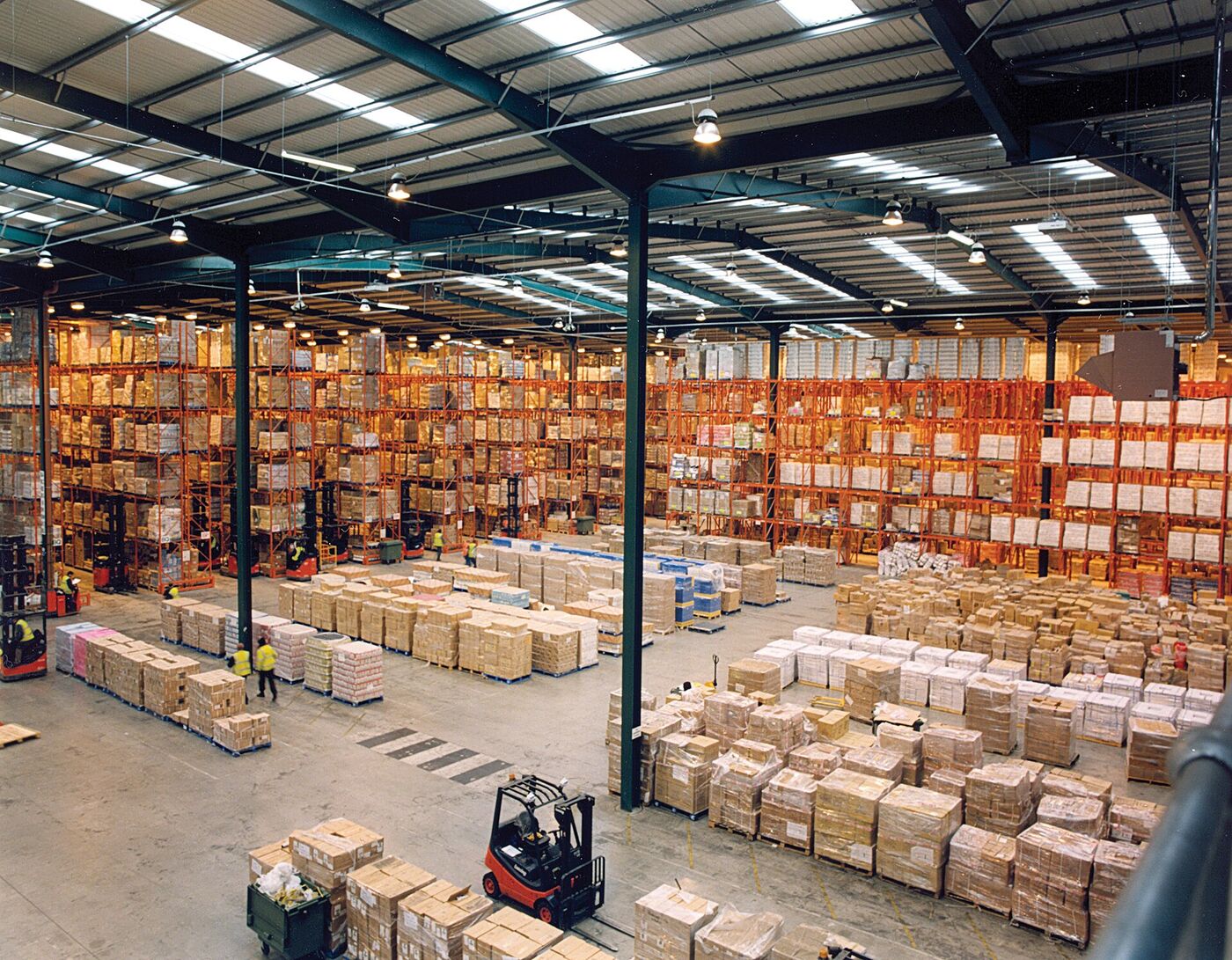

Reach trucks place loads ten metres up in aisles barely wider than the truck. Sideways seating, pantograph reach, tall masts and tight clearances make them a different discipline from counterbalance driving.
How a reach truck works
A reach truck carries its load inside its wheelbase, on a mast that moves forward on a reach mechanism to place the load and retracts to travel. The outrigger legs at the front support the load, so the truck needs no counterweight and can be much shorter than a counterbalance truck of the same capacity. That is what lets it turn in a narrow aisle. The operator usually sits sideways, looking along the truck, and travels with the forks trailing.
The trade-offs are a lower ground clearance and smaller wheels, which restrict reach trucks to smooth indoor floors, and a mast that can reach heights where the operator cannot see what the forks are doing.
Travelling
- Mast fully retracted and forks lowered to around 150 mm before moving off. Travelling with the mast extended puts the load outside the wheelbase and the truck behaves like an overloaded counterbalance.
- Travel with the forks trailing (load end behind) in aisles, so the operator faces the direction of travel. Reverse only for short positioning moves.
- Sideways seating means the operator's neck does the work of mirrors. Slow down at aisle ends and use the horn.
- Floors must be flat, clean and dry. A wet patch or a loose strapping band under a small wheel can stop the truck dead or throw the load.
Working at height
- At full height the forks may be ten metres above the operator. Use the mast camera or height indicator if fitted, and if not, take it slowly and be prepared to lower and reposition.
- Check the capacity at the height you are lifting to. Reach truck capacity falls steeply with height, and the plate will show a lower figure for the top beam levels.
- Extend the reach only when the forks are at beam height and the truck is stationary. Retract before lowering.
- Never leave a load extended and raised while doing anything else.
- Beware the mast on descent. Lowering a tall mast quickly with a heavy load can lift the rear of the truck.
Narrow aisle hazards
- Rack impacts are almost inevitable without discipline. Uprights at aisle entrances should be protected, and every knock reported. See the racking guide.
- Pedestrians in a narrow aisle have nowhere to go. Aisles should be closed to pedestrians while trucks are working, with barriers or a signalling system at each end.
- Two trucks in one aisle is one too many. Use a one-truck-per-aisle rule or a traffic light system.
- Sprinkler heads, lights and roof structure are within reach of a tall mast. Set a maximum lift height for each aisle and mark it.
Very narrow aisle trucks
Very narrow aisle (VNA) trucks, whether man-down turret trucks or man-up order pickers, are guided by wire or rail and work in aisles so tight that the truck cannot turn. They need their own training and certificate. Man-up trucks lift the operator with the load, so the operator wears a harness clipped to the cab and the truck is a piece of equipment used to lift people, with the six-monthly thorough examination that implies.
Cold stores
Reach trucks are the standard truck in cold stores, where the added hazards are condensation on the truck when it comes out, ice on floors, reduced battery performance, restricted operator movement in cold-weather clothing, and time limits on exposure. Cold store work needs its own risk assessment and its own specific job training.
Key points
- Retract the mast and lower the forks before travelling. An extended mast makes the truck unstable.
- Capacity falls steeply with lift height. Check the plate for the level you are working at.
- Close aisles to pedestrians while trucks are working and keep to one truck per aisle.
- VNA and man-up trucks need their own training, and man-up trucks lift people, so LOLER applies.
- Cold stores need their own risk assessment and specific training.
Sources and further reading
- HSE L117
- HSE, Warehousing and storage (HSG76)
- BITA guidance on reach and VNA trucks